How Cloud Kitchens Use Data Analytics to Optimize Menus and Predict Local Food Trends
Meta Description: Discover how cloud kitchens use data analytics, customer insights, and AI-powered forecasting to optimize menus, predict local food trends, reduce waste, and increase profitability.
Introduction
Cloud kitchens operate in a fast-changing food delivery market where customer preferences, local demand, and competition can shift quickly. A menu that performs well today may lose popularity tomorrow, while a new food trend can create an opportunity for businesses that recognize it early.

Instead of relying solely on intuition, cloud kitchen operators can use data analytics to understand customer behavior, identify emerging preferences, and make informed menu decisions. By turning order histories and market signals into actionable insights, they can adapt their offerings to local demand while protecting operational efficiency and profitability.
1. Turning Order Data Into Menu Insights
Every online order provides useful information about customer preferences. Cloud kitchens can analyze sales volume, order frequency, average order value, popular combinations, and repeat purchases to understand which menu items perform best.
For example, if customers in a particular delivery area regularly order protein-rich bowls during lunch hours, the kitchen may consider expanding that category or testing new variations.
Operators can also identify underperforming dishes. Removing or improving products that consistently generate low sales may simplify inventory management and free up kitchen capacity for more profitable options.
The key is to evaluate performance over a meaningful period rather than making major changes based on a few unusual days.
2. Predicting Local Food Trends Before They Peak
Food preferences vary by neighborhood, season, price range, and customer demographics. A dish that becomes popular in one location may not attract the same demand elsewhere.

Data analytics helps cloud kitchens recognize these differences by examining local order patterns, search behavior where available, customer feedback, and seasonal sales trends.
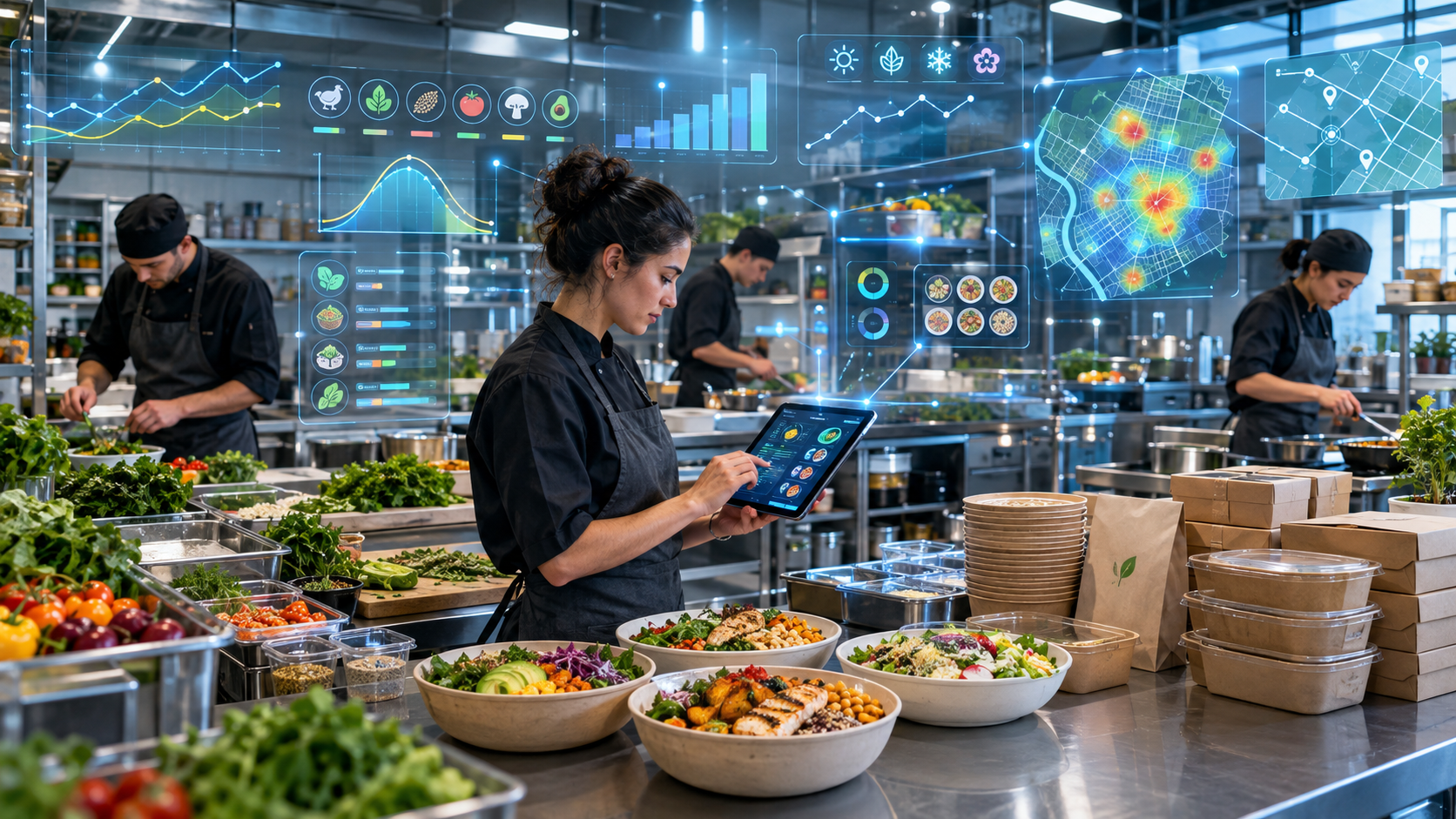
AI-powered forecasting can combine historical demand with relevant external signals to estimate which products may gain popularity. For instance, rising demand for plant-based meals or lighter lunch options may indicate an opportunity to test new menu items.
These predictions are not guarantees. Operators should treat them as evidence for controlled experiments, using limited-time offers or small menu launches before committing significant resources.
3. Using Customer Feedback to Refine Menus
Sales numbers show what customers purchase, but feedback helps explain why they like or dislike particular dishes.
Cloud kitchens can analyze ratings, written reviews, customer support messages, and repeat-order behavior to identify recurring themes. Customers may praise generous portions while frequently mentioning slow preparation, excessive packaging, or inconsistent seasoning.
These insights can guide practical improvements to recipes, portion sizes, packaging, and presentation.
Sentiment analysis tools can help organize large volumes of feedback, but human review remains important because automated systems may misunderstand sarcasm, context, or regional expressions.
4. Adapting Menus to Local Demand and Profitability
A popular item is not necessarily a profitable one. Ingredient costs, preparation time, packaging, delivery fees, and food waste all affect its financial contribution.
By combining sales data with cost information, operators can identify products that balance customer demand with healthy margins.
For example, a cloud kitchen may discover that two dishes sell equally well, but one requires more preparation time and specialized ingredients. Adjusting its recipe, price, or availability could improve profitability without compromising customer satisfaction.
Local adaptation can also include offering different portion sizes, adjusting spice levels, introducing seasonal ingredients, or creating bundles suited to neighborhood purchasing habits.
5. Reducing Food Waste With Demand Forecasting
Poor demand estimates can leave cloud kitchens with excess ingredients or insufficient stock during busy periods.
Forecasting tools can use historical sales, day-of-week patterns, seasonal changes, promotions, and current order activity to estimate future demand. Better forecasts help managers plan purchasing, schedule preparation, and reduce unnecessary inventory.
These benefits depend on data quality and regular review. Unexpected events, supplier disruptions, weather changes, and local holidays can still affect demand, so forecasts should support decisions rather than replace operational judgment.
6. Testing Changes and Measuring Results
The most effective cloud kitchens treat menu optimization as an ongoing process. Before making a permanent change, operators can test a new dish in a limited delivery area or offer it for a defined period.
They should measure results using indicators such as sales conversion, repeat purchases, contribution margin, preparation time, customer ratings, and ingredient waste.
Comparing these results with the existing menu helps determine whether the change delivers genuine value. Successful experiments can then be expanded gradually, while weaker ideas can be revised or discontinued.
Conclusion
Data analytics gives cloud kitchens a clearer understanding of what customers want, how local food preferences evolve, and which menu decisions support sustainable growth. By combining order histories, customer feedback, cost analysis, and demand forecasting, operators can make smarter choices about product development and inventory planning.
The strongest strategy is not to chase every emerging trend. It is to identify relevant local opportunities, test them carefully, and use measurable results to refine the menu over time. With a disciplined, data-driven approach, cloud kitchens can respond to changing customer needs while improving efficiency, reducing waste, and building long-term profitability.