The Economics of Ghost Kitchens: Profit Margins, Cost Structure, and Scaling Playbooks
Meta Description: Explore ghost kitchen profit margins, operating costs, and scaling strategies. Learn how NaanDash supports smarter restaurant operations and delivery business growth.
Introduction
Ghost kitchens are changing the food service industry by allowing businesses to prepare meals exclusively for delivery and takeaway. Without the need for a traditional dining area, these businesses can reduce certain overhead expenses, reach customers online, and experiment with multiple virtual restaurant brands.

However, operating without a dining room does not automatically guarantee higher profits. Food costs, labor, packaging, delivery commissions, marketing, and kitchen rent all affect financial performance.
Understanding the economics of ghost kitchens helps owners make better decisions about pricing, cost management, and expansion. With a clear financial strategy and the right technology, businesses can build a more sustainable operation. Platforms such as NaanDash can also be explored as part of a broader approach to improving restaurant operations and delivery efficiency.
1. Understanding Ghost Kitchen Profit Margins
Profit margins show how much revenue a business retains after paying its expenses. For ghost kitchens, profitability depends on menu pricing, order volume, ingredient costs, staffing efficiency, and delivery expenses.
Ghost kitchens may save money on dining-room furniture, customer-facing space, and some front-of-house labor. However, delivery platform commissions, packaging, discounts, and customer acquisition costs can reduce these savings.
Business owners should understand three important financial measures:
- Gross profit: Revenue remaining after deducting the direct costs of food sold.
- Contribution margin: Revenue remaining after variable costs associated with fulfilling orders, such as ingredients, packaging, and applicable transaction or delivery fees.
- Net profit: Revenue remaining after all business expenses, including rent, payroll, utilities, marketing, and administration.
Tracking these measures helps operators identify whether their kitchens are generating sustainable profits instead of simply processing a high volume of orders.

2. Breaking Down the Ghost Kitchen Cost Structure
Managing expenses is essential for maintaining healthy profit margins. Ghost kitchen costs generally fall into several categories.
Food and Ingredient Costs
Ingredients are among the most important variable expenses. Food waste, inaccurate purchasing forecasts, inconsistent portion sizes, and supplier price increases can reduce profitability.
Standardized recipes, portion control, inventory tracking, and supplier comparisons help control food costs while maintaining consistent quality.
Rent and Kitchen Infrastructure
Ghost kitchens often require less customer-facing space than traditional restaurants. Nevertheless, commercial kitchen rent, equipment, maintenance, utilities, refrigeration, and food safety compliance remain important expenses.
Shared kitchen facilities may reduce initial investment, but operators should evaluate rental agreements, equipment access, storage availability, and additional service fees before committing.
Labor and Order Preparation
Labor costs depend on order volume, menu complexity, operating hours, and preparation requirements. Overstaffing during quiet periods can waste resources, while understaffing during peak demand can cause delays and mistakes.
Demand forecasting, staff scheduling, and standardized preparation processes help businesses align labor with actual workload.
Packaging, Delivery, and Marketing
Packaging protects food during transportation but adds a cost to every order. Delivery commissions, payment processing fees, online advertising, and promotional discounts can further reduce revenue.
Operators should calculate the complete cost of fulfilling each order instead of focusing only on ingredient expenses.
3. Calculate the True Profitability of Every Order
A ghost kitchen can generate significant sales and still struggle financially if individual orders contribute too little toward fixed expenses.
Consider an illustrative meal sold for $25:
| Item | Amount |
|---|---|
| Selling price | $25.00 |
| Ingredients | −$7.00 |
| Packaging | −$1.50 |
| Delivery platform commission (illustrative 20%) | −$5.00 |
| Variable labor and payment costs | −$3.00 |
| Contribution per order | $8.50 |
In this example, the contribution margin is 34% of the selling price. The remaining $8.50 helps cover fixed expenses such as rent, fixed payroll, utilities, and other overhead before the business generates net profit.
These figures are examples, not industry averages. Actual costs depend on the location, menu, staffing model, and delivery arrangements. The commission calculation also assumes the fee is based on the full $25 selling price.
Understanding contribution margin helps owners determine which menu items are profitable, where pricing adjustments may be necessary, and which expenses need closer attention.
4. How Technology Can Improve Ghost Kitchen Economics
Technology can help ghost kitchens make informed decisions, coordinate orders, and reduce avoidable operational costs.
Inventory management tools help track ingredients and identify purchasing requirements. Order management systems organize incoming orders, while reporting dashboards help operators evaluate sales trends, menu performance, and operational bottlenecks.
Delivery coordination is another important consideration. Poorly timed pickups and inefficient dispatch can increase waiting times, affect food quality, and create unnecessary delivery expenses.
NaanDash is relevant to businesses exploring digital solutions for restaurant operations and delivery-focused workflows. Before selecting a platform, operators should review its current features, integrations, pricing, and suitability for their specific business model.
The objective is to invest in technology that delivers measurable value, whether through reduced administrative work, better order coordination, or improved operational visibility.
5. Scaling Playbooks: How Ghost Kitchens Grow Profitably
Expanding a ghost kitchen requires more than increasing sales. Businesses should establish reliable unit economics, confirm customer demand, and develop repeatable operating processes before investing in growth.
Playbook 1: Optimize the Existing Kitchen
Before opening another location, improve the performance of the current operation.
Review menu profitability, reduce food waste, standardize recipes, improve staff scheduling, and identify unnecessary expenses. Even small improvements across a large number of orders can increase total contribution.
Playbook 2: Expand Through Virtual Brands
Virtual brands allow one kitchen to serve different customer segments without building separate physical restaurants.
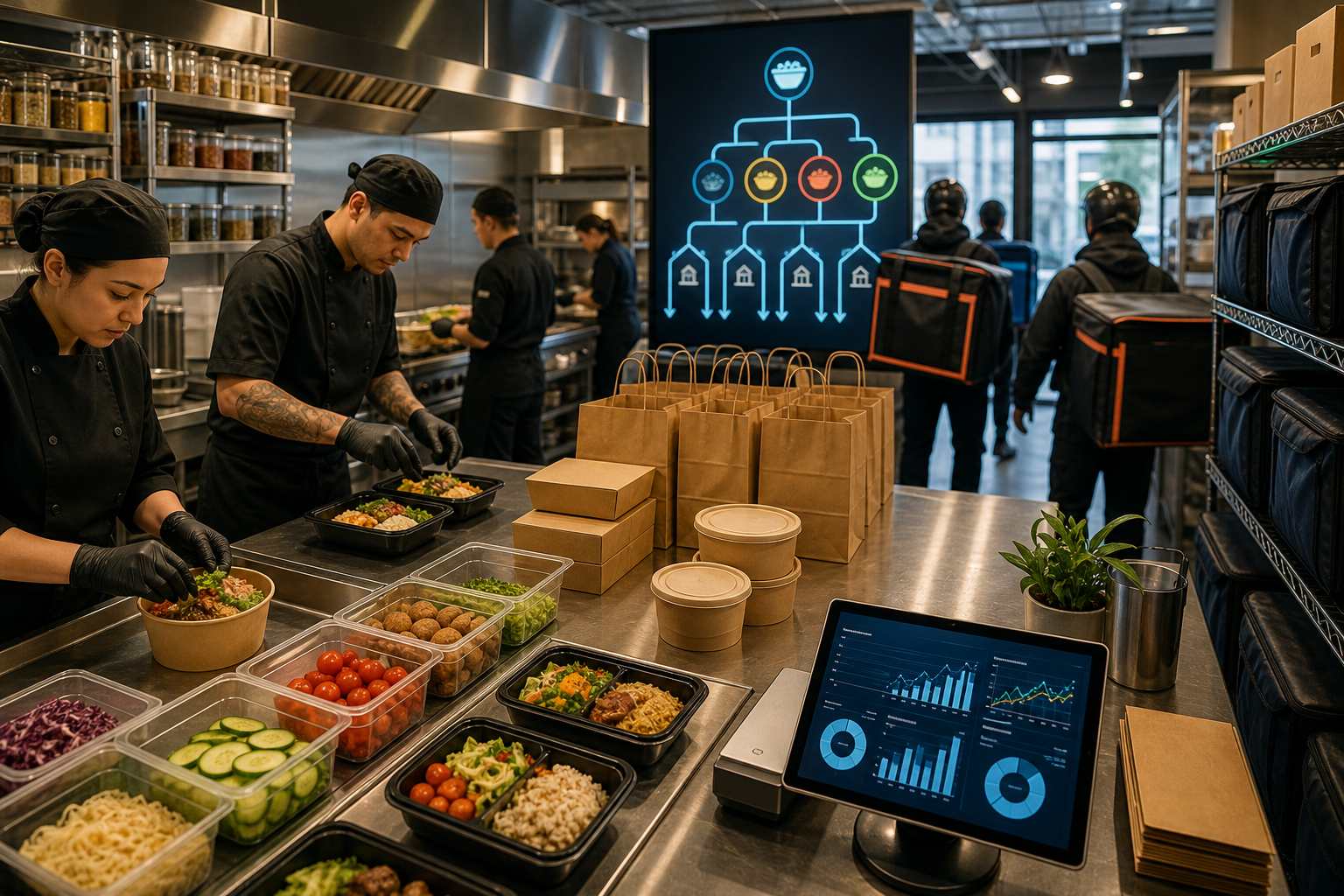
For example, a kitchen might operate a burger brand, a healthy meal brand, and a dessert brand using shared equipment and selected ingredients.
Each brand should have a clear identity, a distinct target audience, and a viable financial model. Launching too many brands without sufficient demand can increase complexity and marketing expenses rather than improve profitability.
Playbook 3: Use Data to Guide Expansion
Before entering a new delivery zone, examine order density, customer retention, average order value, delivery expenses, and contribution margin.
A location with high demand may still be unattractive if delivery costs are excessive. Conversely, a smaller market with repeat customers and efficient fulfillment may offer better long-term returns.
Use realistic forecasts and actual operating data to determine whether additional locations, longer operating hours, or expanded menus are financially justified.
Playbook 4: Standardize Operations Before Replicating
Successful expansion depends on consistent processes. Document recipes, food preparation procedures, inventory controls, staff training, quality checks, and delivery handoffs.
Standardization helps maintain food quality and service reliability as order volumes increase or new locations open.
Technology can support these processes by making operational information easier to access and helping teams coordinate their responsibilities.
6. Key Metrics Every Ghost Kitchen Should Track
Regular financial reviews help ghost kitchen operators identify problems before they become expensive.
Important metrics include:
- Food cost percentage: Food costs divided by food sales.
- Labor cost percentage: Labor expenses divided by revenue.
- Contribution margin per order: Revenue remaining after variable fulfillment costs.
- Average order value: Average revenue generated per transaction.
- Customer acquisition cost: Marketing expenditure required to acquire a customer.
- Repeat purchase rate: The percentage of customers who place additional orders within a defined period.
- Break-even order volume: The number of orders needed to cover fixed expenses at the current contribution per order.
For example, if monthly fixed costs are $8,500 and each order contributes $8.50, the business needs approximately 1,000 orders per month to cover those fixed costs, assuming the contribution margin remains consistent.
Monitoring these indicators helps owners refine pricing, evaluate promotions, control expenses, and make more confident expansion decisions.
Conclusion
The economics of ghost kitchens depend on disciplined cost management, profitable menu design, efficient delivery operations, and sustainable customer acquisition. Although delivery-focused kitchens can reduce certain traditional restaurant expenses, profitability still requires careful control of ingredients, labor, packaging, delivery fees, and overhead.
Successful operators understand their contribution margins, monitor performance consistently, and expand only when their business model demonstrates repeatable results.
By combining sound financial planning with efficient workflows and appropriate technology, ghost kitchens can build a stronger foundation for long-term growth. NaanDash can be explored as part of a broader strategy to support modern restaurant operations and delivery-focused business development.